Game Film Notes
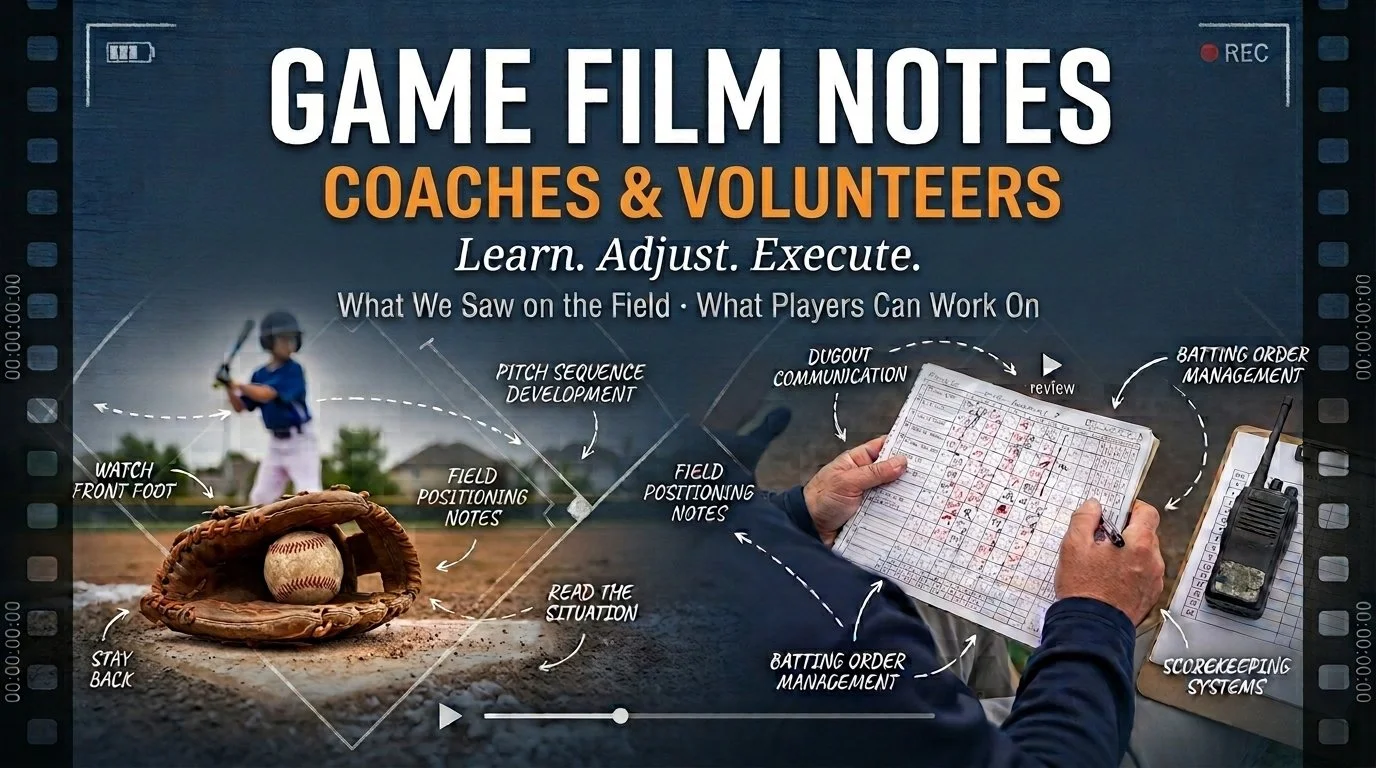
Coaches & Volunteers — Saturday, August 15, 2026
This is the companion to our Players & Families notes. While that post looks at what the boys can take from the game, this one gives us a chance to look at the game from the coaching, dugout, and volunteer side.
Game 1 was our first opportunity to put all of those pieces together in real time — and there was a lot that worked well.
We're still finding our rhythm, and that's part of the process. Just like the boys, we'll keep what worked, learn from what didn't, and get a little smoother each time out.
Thank you, sincerely, to everyone who jumped in and helped make Game 1 happen.
BASE COACHING & COMMUNICATION
Zayn's trip around the bases after his walk was a great example of player awareness and coaching communication working together.
The defense relaxed, our First Base Coach recognized the opportunity, and Zayn responded to the cue. As the play developed, our Third Base Coach recognized the opportunity to send Finley home.
One decision created another.
That's the kind of aggressive baserunning we want when it's supported by awareness and good communication.
As we go, we'll keep making our baserunning cues more familiar and consistent so the boys know what they're hearing and can react confidently.
Game 1 also reinforced something important for us as coaches: the runner's job is to run; our job is to help him see what he can't.
DUGOUT RHYTHM
Game 1 gave us a good first look at how much is happening in the dugout at once.
One of the simplest things we can do is stay ahead of the batting order, especially at the end of an inning.
If the third out happens on the bases while a hitter is still mid-at-bat, that hitter hasn't completed his plate appearance and will return to the plate when we bat again.
So at every third out, let's answer one question:
Who's up next?
Getting that settled before we transition keeps the next inning moving and gives us time to have the right player ready.
The music lineup also gives us a helpful second set of eyes. If something doesn't seem to match, a quick cross-check can help us catch it before the next batter heads to the plate.
HELPING THE BOYS SEE THE GAME
One of our biggest opportunities this season is helping the boys move from simply reacting to the baseball to understanding the situation around it.
That doesn't always mean giving them more instruction.
Sometimes they need a clear cue in the moment. Sometimes a question after the play teaches more. And sometimes we need to give them room to make the decision themselves.
We're building players who can eventually recognize the play without someone telling them where to go.
Early on, we may say:
“Go here.”
Later, we can ask:
“Where's your play?”
Eventually, they'll see it themselves.
That's the progression we're working toward.
GAME RECORDING & SCOREKEEPING
Game 1 also gave us our first real look at how GameChanger, the scoreboard, manual scorebook, and pitch count can work together.
There's a lot happening quickly, and unusual plays can create several updates at once.
Having multiple sets of eyes is an advantage.
Whenever possible, our game-recording crew can stay connected and cross-check anything unusual in real time. If something doesn't look right, check with one another first — someone else may have caught what was easy to miss.
And for everyone else, giving that crew a little space during live play helps tremendously. Even a quick conversation can make it easy to miss a pitch or play.
We're not looking for perfection here either.
The goal is a system that gets easier and more accurate every game.
THE DUGOUT EXPERIENCE
Beyond batting order and field execution, we also want to keep building a dugout where the boys stay connected to the game and to one another.
They're learning baseball, but they're also learning how to be teammates.
We can help by keeping the environment positive, redirecting distractions when needed, and encouraging the boys to watch the game, support one another, and stay ready for their next opportunity.
The more comfortable our adults become in their own roles, the easier it becomes to create that environment for the players.
WHAT WE'RE TAKING WITH US
Game 1 gave us a solid starting point.
We'll keep building:
Clear, consistent communication from our base coaches.
Smooth batting-order and inning transitions.
Opportunities for players to think through situations rather than simply being told what to do.
Strong coordination between GameChanger, scorebook, scoreboard, and pitch count.
A positive, engaged dugout.
Clear roles and good communication across the entire game-day team.
Nothing here needs to become complicated.
We're simply doing what we're asking the boys to do: pay attention, learn from the experience, and bring a little more understanding into the next game.
Thank you again to everyone who showed up and took on a role for Game 1. These boys have a lot of adults giving their time and attention to create a great baseball experience for them, and that matters.
Learn. Adjust. Execute.
Read the other half of this week's notes: Game Film Notes — Players & Families
We hope these notes are useful to our Renegades coaches and volunteers as we continue learning and refining together. Have a thought, question, or something to add? Join us in the comments below.